Good morning. This week, the U.S. Securities and Exchange Commission addressed a long-running debate on Wall Street: Are quarterly earnings reports helping investors—or fueling short-term earnings management?
On Tuesday, the agency announced a proposed rule and form amendments that would allow semiannual reports to satisfy interim obligations under federal securities laws. The proposal is not final; comments will remain open until 60 days after Federal Register publication.
“Public companies have an obligation under the federal securities laws to provide information that is material to investors,” SEC Chairman Paul S. Atkins said in a statement. “Yet, the rigidity of the SEC’s rules has prevented companies and their investors from determining for themselves the interim reporting frequency that best serves their business needs and investors.” If adopted, the changes would provide “increased regulatory flexibility in this regard,” he said.
The SEC says the change would be optional. A spokesperson told me that companies would weigh peer comparability, analyst requests, and investor expectations when deciding whether to opt in.
Kristina Wyatt, EVP and general counsel at The Conservation Fund and a former SEC senior counsel, told me that she sees both sides.
“On the one hand, public companies are so focused on meeting quarterly expectations that that can foster short-term thinking,” Wyatt said. “The burdens on companies from the quarterly reporting cycles are significant and that may, in part, feed into the flight to the private markets that we’ve seen over the last 20 years in this country.” However, she added, “investors need to have equal and fair access to material information about companies to help inform their investment decisions and to foster accurate pricing under the Efficient-Market Hypothesis.”
Wyatt said quarterly reporting and Form 8-K disclosures support transparency and informational parity. If semiannual reporting becomes optional, regulators should scrutinize disclosures between reports, potentially strengthening Form 8-K and enforcing Regulation FD to prevent selective disclosure.
Wyatt sees three risks: greater informational asymmetry and reduced pricing efficiency; higher risk premiums and cost of capital; and more reliance on third-party information, which could reduce accuracy and accountability. With AI spreading third-party data, company-certified filings may become more important.
In a Fortune opinion piece, Kunal Kapoor, CEO of Morningstar, argues semiannual reporting could reduce burdens, especially for smaller firms, and make public markets more attractive if disclosure remains strong. He says incentives drive short-termism more than reporting frequency.
Meanwhile, Shivaram Rajgopal, a professor of accounting and auditing at Columbia Business School, is more skeptical. “In the U.K., when something similar was enacted, very few firms stopped quarterly reporting in the short run,” Rajgopal said. “But over the period of a decade or so, everyone stopped reporting quarterly.”
He argues that relying on Form 8-K disclosures misses the value of interim financial statements, which translate events into concrete financial metrics. “Forms 10-Q serve that market need,” he said. Potential downsides include more insider activity, greater volatility and surprises, and reduced analyst coverage. Rajgopal also questions whether the proposal addresses short-termism. “This is a solution looking for a problem,” Rajgopal said. “Myopia over three months, the intended target, will simply be myopia over six months. What exactly have we accomplished?”
The debate will continue.
Have a good weekend.
Sheryl Estrada
sheryl.estrada@fortune.com
Leaderboard
Fortune 500 Power Moves
Theodora “Doretta” Mistras, CFO of Viatris Inc. (No. 298), a global pharmaceutical company, will depart the company for a new professional opportunity. Paul Campbell, currently chief accounting officer and corporate controller, will serve as interim CFO, effective May 8, while the company conducts its search for a permanent successor. Mistras will remain at Viatris until May 22, for a transition period.
Every Friday morning, the weekly Fortune 500 Power Moves column tracks Fortune 500 company C-suite shifts—see the most recent edition.
More notable moves this week:
Michelle Hook was appointed CFO of Shake Shack Inc. (NYSE: SHAK), effective May 11. Hook brings more than two decades of experience in the restaurant industry. She joins Shake Shack from Portillo’s, where she served as CFO beginning in December 2020. In that role, she helped take the company public in 2021. Previously, Hook spent more than 17 years at Domino’s Pizza, Inc., where she most recently served as VP of finance for global FP&A and investor relations, and held various accounting and finance leadership positions.
Chris Monroe was appointed EVP and CFO of CEC Entertainment, LLC, the parent company of Chuck E. Cheese and Peter Piper Pizza. Monroe brings more than 30 years of experience across the restaurant, aviation, and defense sectors. Monroe most recently served as CFO of Texas Roadhouse. Before that, Monroe spent more than three decades at Southwest Airlines, ultimately serving as SVP of finance, treasurer, and sustainability.
Paul DiCicco was appointed EVP, CFO, and treasurer of Madison Square Garden Sports Corp. (NYSE: MSGS), effective May 11. DiCicco has 30 years of experience. He joins MSG Sports from Stephen Gould Corporation, where he served as CFO. Before that, DiCicco was at Harris Blitzer Sports and Entertainment, where he served as SVP and corporate controller. DiCicco’s experience also includes various senior finance and accounting roles at both public and private companies in the U.S. and Asia.
Jennifer Kartychak was promoted to CFO of Worksport Ltd. (Nasdaq: WKSP) a manufacturer of hybrid and clean energy solutions, effective May 1. Kartychak has worked with Worksport since August 2023 through Arend Advisory Group, LLC, an entity wholly owned by her, before joining the company full-time as VP of finance on Jan. 1, 2026. Kartychak brings over 25 years of accounting experience.
Michael Mioska was appointed CFO of Birchtech Corp. (NYSE American: BCHT), an activated carbon technology provider. Mioska has over 20 years of accounting, audit, and financial reporting experience. Mioska has been an independent consultant providing finance, financial reporting, and M&A advisory-related services to a range of public companies since 2021, including Birchtech since 2023. Before that, Mioska worked at a public accounting firm in Vancouver, BC providing similar finance services since 2005.
Jorge Beristain was appointed CFO of Almonty Industries Inc. (Nasdaq: ALM) a global producer of tungsten, effective June 1. Brian Fox has departed from his role as CFO effective immediately. Until Beristain’s start date, Guillaume de Lamaziere, the company’s chief development officer, will serve as interim CFO. Beristain most recently served as VP of finance at Ryerson Holding Corp. He previously served as CFO of Central Steel & Wire Co.
Kari Wimmer was appointed CFO of Couchbase, Inc., an operational data platform for AI. Wimmer brings more than two decades of experience in corporate finance, M&A, and strategic development. She joins the company from Intellistack, where she also served as CFO. Previously, Wimmer served in senior executive roles at Businessolver, P2 Energy Solutions, and Arrow Electronics.
Big Deal
However, there were mixed signals beneath the surface. Small business payroll growth was negative in March, even as some sectors, including construction and manufacturing, showed signs of ramping up hiring, according to Bank of America data.
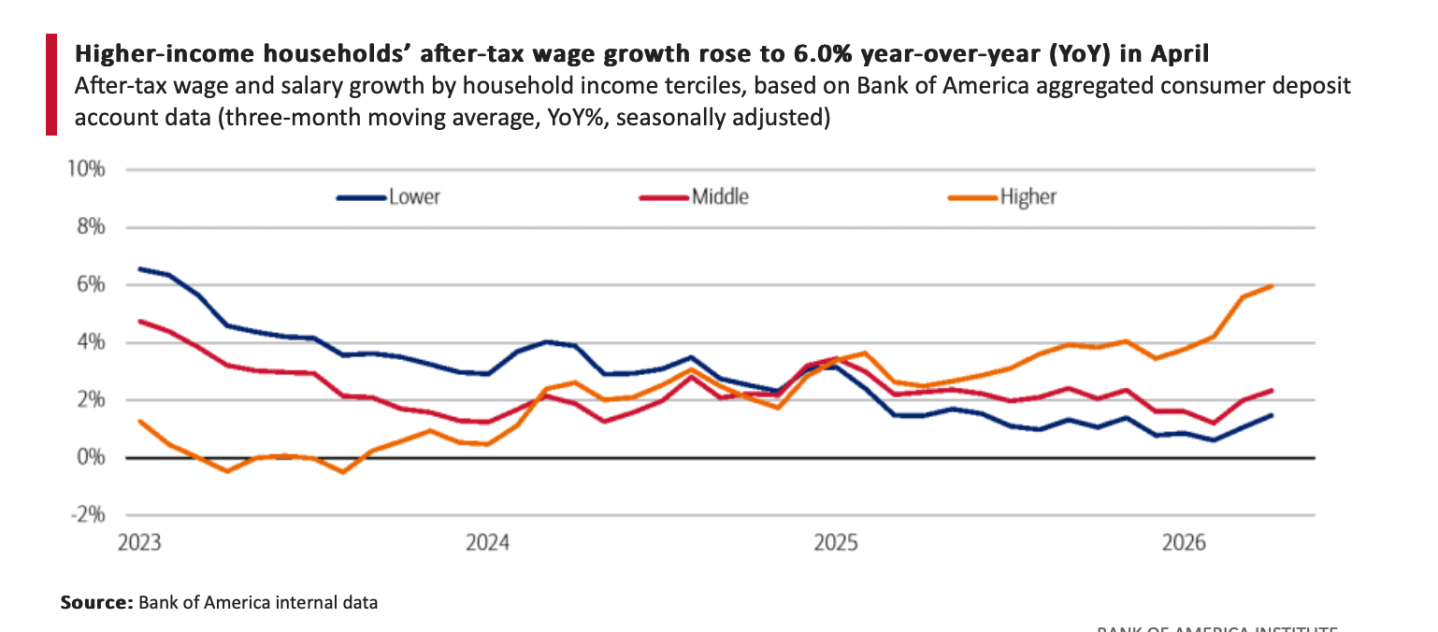
In addition, a divergence in wage gains persisted. Wage growth remained “K-shaped” in April: After-tax wage growth for higher-income households was 6% year over year, while middle- and especially lower-income households saw much weaker gains.
Going deeper
Here are four Fortune weekend reads:
“U.S. Treasury will have to borrow $2 trillion this year just to continue functioning—more than $166 billion every month” —Eleanor Pringle
“Why CEO Bill McDermott says ServiceNow’s 39% stock crash is Saaspocalypse ‘nonsense’ and why AI will make it a trillion-dollar company” —Alexei Oreskovic
“Match Group’s CEO revived a shuttered Tinder internship program for Gen Z—and received over 30,000 applications for just 27 spots” —Emma Burleigh
“Gen Z just broke the streaming model: A majority subscribe, binge, and cancel over and over, study finds” —Jake Angelo
Overheard
“I think it’s important to know that you can have both ambition and limits at the same time. You can go after something fully and still have a say in what it costs you.”
—Naomi Osaka, a four-time Grand Slam champion, writes in a Fortune opinion piece. Osaka is the ambassador for OLLY’s “Do What Serves You” 2026 campaign in support of Mental Health Awareness Month.