Ellie House and Mike WendlingGainesboro, Tennessee
 BBC/Ellie House
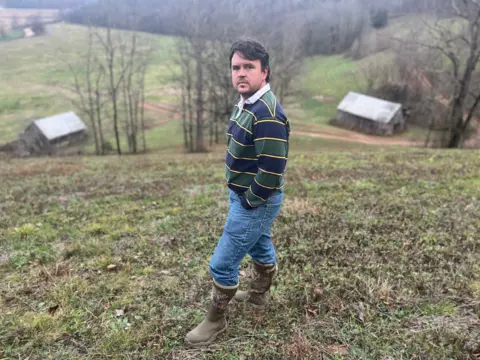
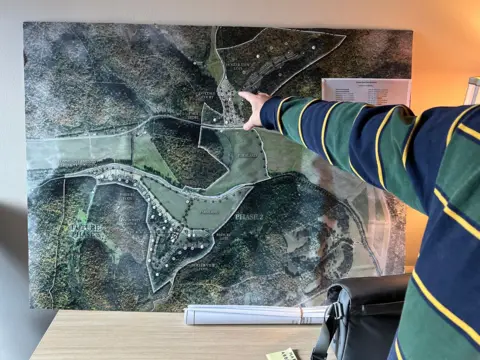
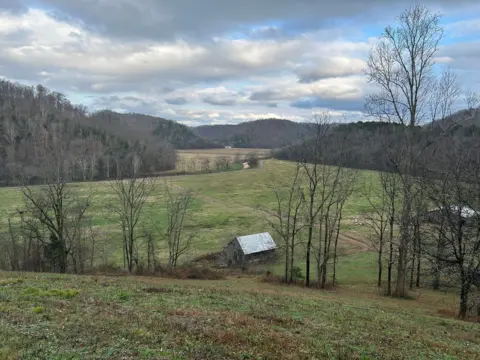
As Josh Abbotoy gazes out at lush green woods and pastureland nestled among Tennessee’s Appalachian hills, he describes what he intends to build here: a neighbourhood with dozens of residential lots, centred around a working farm and, crucially, a church.
“A customer might very well buy and build roughly where we’re standing right now,” he says as we hike up to the top of a ridge.
Mr Abbotoy is founder of the real estate company Ridgerunner, which has bought land here and in neighbouring Kentucky. But his is no garden-variety housing development.
Mr Abbotoy is prominent in US conservative circles and describes his development as an “affinity-based community” – marketed to people not only interested in the peace and quiet of rural life, but in a constellation of right-wing ideals.
“Faith, family and freedom,” he says. “Those are the values that we try to celebrate.”

 BBC/Mike Wendling
Initially he didn’t attract much local attention after setting up shop in Jackson County.
But in late 2024, a local TV news report broadcast controversial statements made by two of Mr Abbotoy’s first, and most outspoken, customers: Andrew Isker, a pastor and author originally from Minnesota, and C Jay Engel, a businessman from California.
They are self-described “Christian nationalists” who question modern values, such as whether female suffrage and the civil rights movement were good ideas, and call for mass deportations of legal immigrants far in excess of President Donald Trump’s current plan. Another thing they sometimes say: “Repeal the 20th Century.”
The TV report raised an alarm bell amongst some local residents.
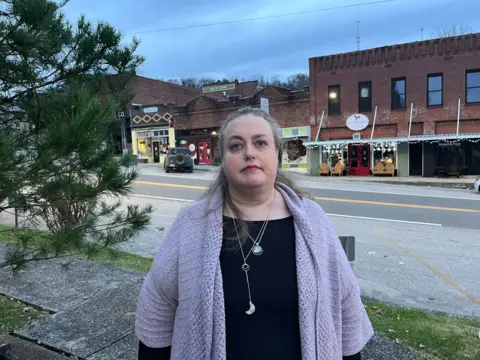
“You don’t know who these people are, or what they’re capable of,” says Nan Coons, a middle-aged woman who spoke in a firm southern accent during a recent interview near the town square in Gainesboro – of which this land is a part.
“And so it’s scary.”
Although Abbotoy himself does not identify as a Christian nationalist, he says concerns about his tenants are overblown.
The Ridgerunner development has since drawn national attention. And people in Gainesboro, home to around 900 people and one traffic light, have now found themselves in the middle of a dispute that is a proxy for much bigger political battles.
Podcasters move in
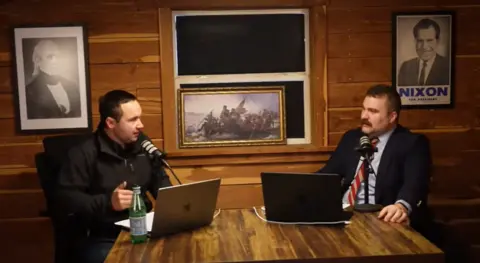
Mr Isker and Mr Engel announced their move to Gainesboro last year on their podcast Contra Mundum – Latin for “against the world”.
On their show, which is now recorded in a studio within Ridgerunner’s Gainesboro office, they have encouraged their fans to move into small communities, seek local influence, and join them in their fight to put strict conservative Christian values at the heart of American governance.
“If you could build places where you can take political power,” Mr Isker said on one episode, “which might mean sitting on the [board of] county commissioners, or even having the ear of the county commissioners and sheriff… being able to do those things is extremely, extremely valuable.”
 Contra Mundum
On X, Mr Engel has popularised the idea of “heritage Americans” – a fuzzy concept but one that applies mainly to Anglo-Protestants whose ancestors arrived in the US at least a century ago. He says it is not explicitly white, but it does have “strong ethnic correlations”.
He’s called for mass deportations of immigrants – including legal ones – writing: “Peoples like Indians, or South East Asians or Ecuadorians or immigrated Africans are the least capable of fitting in and should be sent home immediately.”
In their broadcasts and writings they have also expressed anti-gay sentiments. The podcasters deny they are white nationalists.
Both are Ridgerunner customers, and Mr Isker’s church will move into the community’s chapel when it’s complete.
The ‘resistance’
Their hardcore views have alarmed residents, with some locals setting up an informal resistance group.
“I believe that they have been attempting to brand our town and our county as a headquarters for their ideology of Christian nationalism,” says town matriarch Diana Mandli, a prominent local businesswoman who until recently owned a pub on Gainesboro’s central square
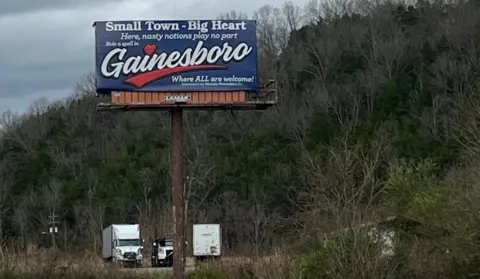
Late last year, Mandli led the charge by writing a message on a chalkboard outside her business: “If you are a person or group who promotes the inferiority or oppression of others, please eat somewhere else.”
 BBC/Mike Wendling
More signs opposed to the new development followed. When people caught wind that the Ridgerunner guys were holding a meeting at a nearby fast food joint, dozens turned up to confront them.
Ms Coons, whose ancestors have lived in Gainesboro since around the time of the US Revolutionary War, says she engaged Mr Engel in conversation.
“He explained to me that what they’re promoting is what he called ‘family voting’… one vote per family, and of course, the husband in that family would be the one voting” with women frozen out of the electorate.
Mr Engel has since said publicly that it’s not “wrong” for women to vote, although he does support the idea of household suffrage.
 BBC/Mike Wendling
In a county that voted 80% for Donald Trump in the last election, Ms Coons is used to living next door to neighbours with conservative views.
But she and others came away from the protest convinced more than ever that the beliefs of their new neighbours were too extreme.
They say they don’t want to run them out of town, but intend to sound the alarm about what they say are extreme views, as well as thwart any future attempt to take over the local government.
“This is where we have to draw the line,” Ms Coons says.
What is Christian nationalism?
Christian nationalism is a nebulous worldview without a single coherent definition.
At the extreme end, as outlined by theorists including author Stephen Wolfe, Christian nationalists advocate for rule by a “Christian prince” – an all-powerful religious dictator, who reigns over the civil authorities and leads his subjects to “godliness”.
Less extreme versions take the form of calls for Christian law to be explicitly enshrined in American legal codes, for religious leaders to get heavily involved in politics, or simply for an acknowledgement of the Christian background of America’s founding fathers.
This multiplicity of definitions has created a strategic ambiguity that experts say has helped Christian nationalism seep into the mainstream.
Big ideas or far-right plan?
Mr Abbotoy’s development is still in the early stages – his company is building roads and organising sanitation infrastructure. When the BBC visited in November, workers were busy knocking down a decrepit old barn, one of many that dot the Appalachian landscape.
But business is brisk. Around half of the lots are already under contract. Mr Abbotoy anticipates that the first houses will be built and new customers will begin moving in at the beginning of 2027.
 BBC/Ellie House
Many of his customers, he says, are moving to heavily Republican Tennessee from Democratic-majority states like California and New York.
“People want to live in communities where they feel like they share important values with their neighbours,” he says.
Mr Abbotoy says he doesn’t call himself a Christian nationalist, but describes the criticism of his customers as “absurd” and says they have no intention to try to take over local government.
“They’re talking about big ideas and books,” he says. As for some of their more controversial views, he insists that “rolling back the 20th Century can mean a lot of things. A lot of conservatives would say we took a lot of wrong turns.”
Mr Isker and Mr Engel did not respond to multiple requests for comment and a list of questions.
 BBC/Ellie House
Small-town fight goes nationwide
The fight here in Gainesboro has drawn in players far from small-town Tennessee.
Mr Abbotoy, who was educated at Harvard Law School, is also a partner at a conservative venture capital fund, New Founding, and a founder of the American Reformer, a website that has published the writings of a number of other prominent Christian nationalists.
His opponents meanwhile have received research assistance and advice from a national organisation, States at the Core, established last year to tackle authoritarianism in small communities. It is funded by a constellation of left-wing organisations. States at the Core declined our request for an interview.
The men of Ridgerunner have pointed to the organisation as evidence that the pushback against their project has been orchestrated by powerful liberals. The locals say this is ridiculous.
“Nobody’s cut me a cheque to say anything,” Ms Coons says.
In Gainesboro, people on all sides see a much bigger story – one of large-scale political fights playing out in rural America.
Republicans have made huge gains in rural areas this century, and in 2024 Trump stretched his lead in rural communities, winning 69% of the vote. The Democratic Congressional Campaign Committee recently announced a reported eight-figure investment ahead of the 2026 midterm elections, a chunk of which will be dedicated to winning rural voters.
“There’s definitely a renewed, [Democratic Party] focus on rural engagement,” Mr Abbotoy says. “And at the same time, there’s been a wave of people moving to small town America precisely because they like the Bible Belt, they like the conservative traditional culture.”
But Nan Coons and her allies say they aren’t ready to concede rural areas like her hometown to Christian nationalists.
“If we are going to turn this tide, it starts on your street, it starts in your neighbourhood, it starts in your small town,” she says.
“I have to stand for something, and this is where I stand.”