BBC Berlin correspondent
 BBC
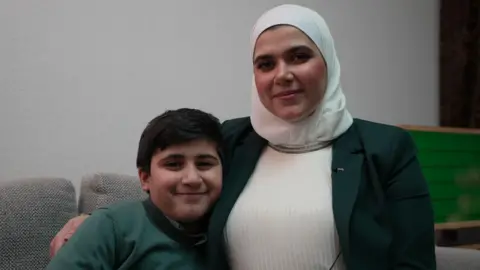
BBC“I was crying,” says Alya, when she noticed information of utmost presen’s Munich assault that left a child and her mom lifeless.
“Why should someone do something like that? Why? I can’t understand it.”
An Afghan guy’s in custody later what was once the actual in a line of assaults in German towns the place the suspect has been an asylum seeker.
Extreme Thursday it was once a mom and daughter in Munich; utmost hour any other kid and an grownup had been killed in Aschaffenburg.
Alya got here right here a decade in the past from Syria together with her child son. Now 10, he and his mom welcome me into their house.
They had been amongst a document 1.2 million population who implemented for asylum in Germany from 2015-16, a lot of them from Syria but additionally from nations together with Afghanistan and Iraq.
The assaults have put safety and migration entrance and centre of an election marketing campaign, days prior to Germans vote on their nearest executive on 23 February.
Alya despairs of those that dedicate violence in a rustic that, she says, has “given us everything”.
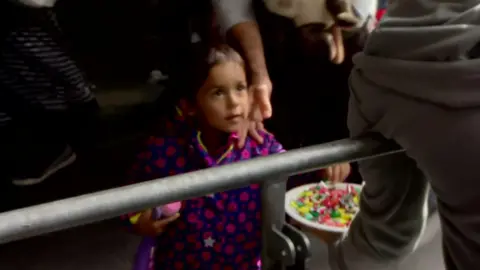
The BBC first heard their tale a decade previous after they had been filmed at a refugee centre within the town of Oberhausen.
Rami appears to be like at a photograph of himself from 2015. He’s little, enveloped in a era jacket from when his mom fled war-torn Syria.
“How could I go with him in that boat?” she asks herself, remembering how they crossed the Aegean Sea with 60 others, packed in a tiny boat.
“I didn’t know I’d gone through that,” says Rami. It scares him to look it now.

Ten years on, Alya has skilled in aged serve and re-married. She is in search of paintings, year Rami is going to an area college and is a passionate soccer fan.
They each discuss German: Rami has grown up with the language and Alya has studied it.
They’re thankful to their followed nation and plan to stick; Rami has desires of turning into a health care provider, policeman or footballer.
Mom and kid have, unsurprisingly, modified within the date 10 years.
So has Germany.
Again in 2015, there have been scenes of candies being passed out to refugees arriving at Munich teach station, as an exceptional collection of population fled to Europe because of warfare, instability or poverty.
German Willkommenskultur, or Welcoming Tradition, was once encapsulated when the upcoming chancellor, Angela Merkel, declared: “We can manage this.”
For her supporters, it was once a practical and compassionate response; for her critics, one in every of her maximum unforgivable errors.
A decade then and any person I’ve spoken to has the same opinion that attitudes have dry, in people and politically.
Alya says she has “lots of German friends” however has detected the wider exchange in temper in Germany and mentions listening to the word Ausländer raus – foreigners out.
Then again she is “very sad” about refugees and migrants who don’t be informed German or, in her view, have failed to correctly combine.
“The key to this country is the language,” she says, year including: “There’s also a positive side that a lot of people have learned the language and they’ve started to work.”
Close Oberhausen’s primary ground, Georg, 66, says he will get on with population from all backgrounds however worries about circumstances of “radicalisation.”
He has lived within the town maximum of his era and impaired to paintings as a automobile mechanic and tiler. He mourns what he sees a common abate in Oberhausen, pointing to on account of aging infrastructure and a shortage of funding.
Many in Germany additionally communicate of a want for better society protection and a disillusionment with the events that experience ruled the rustic since reunification.
Germany’s outgoing executive has reimposed border controls because it tries to deliver i’m sick the collection of asylum seekers, and opposition events need to journey additional.
Georg says it’s a hard factor however believes there must be safety: “No matter who’s in charge. Not like it is right now. It has to change.”
Prior to Europe’s migration extremity, Oberhausen was once already a multicultural town.
Native executive figures display that during 2010, 22% of population in Oberhausen had been both now not born as German voters or had one immigrant dad or mum.
Via 2016, that determine had risen to twenty-eight% year the actual determine, from 2023, was once as much as 37%.
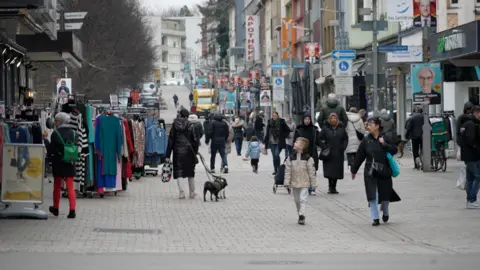
Strolling during the centre, the strained nature of Germany’s migration debate turns into briefly revealed.
Round one nook, there’s an indication towards the far-right Supplementary for Germany (AfD) birthday celebration which has embraced the concept that of “remigration”; a word broadly understood to ruthless pile deportations.
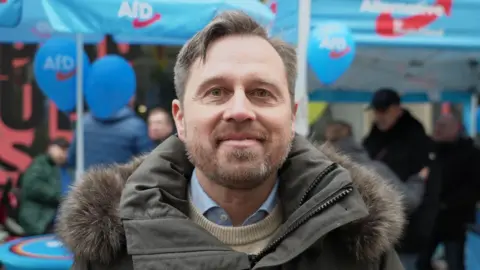
At the primary boulevard, an AfD birthday celebration be on one?s feet has been post, however it quickly draws yells of “Nazis.”
Two males of color finally end up in a blazing argument with birthday celebration activists which we’re overtly filming.
We pay attention one of the crucial AfD campaigners, who we’d been chatting with previous, say: “Go back to your Heimat (homeland) if you don’t like this here.”
Once I problem this guy, Jörg Lange, afterwards, he denies the statement was once racist.
A town councillor, he tells me electorate may have their say and voices scepticism that one of the crucial males grew up right here, in spite of their fluency within the language.
“Would you have said the same thing to a white person?” I ask.
“No, of course not,” Mr Lange replies – however once more denies it’s racist.
“He personally attacked me,” says Mr Lange. “He said ‘you’re a Nazi’. And then of course you have to say that if something doesn’t suit you here in Germany then you can go back. Then leave us alone here.”
Police begin, right through which while I communicate with the 2 males concerned within the argument, Kwame and Prathep, who’re each of their thirties.
“He told us to go back!” says Kwame year Prathep says going “back” would ruthless going about, “Three streets away from here.”
“We went to school over here, we grew up over here… we have kids here,” they inform me. “We pay taxes, we pay a lot of taxes!”
I ask the pair about whether or not their position within the altercation is including to the emerging temperature of political debate.
Kwame, who impaired the time period “Nazis” within the argument, says the “derogatory” language he hears about population of color “triggers” him. “We feel like, wow, are we still in the same place right now?”
A dance choreographer, he tells me he got here to Germany from Ghana elderly 13 year Prathep describes how he was once born within the town.
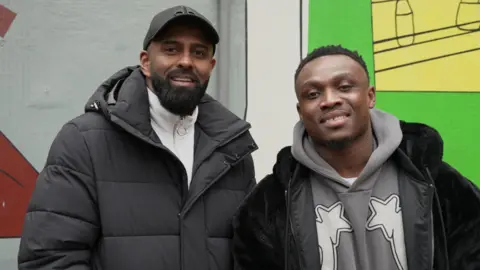
“I’m a German,” says Prathep. “I’m proud of this city,” chimes in Kwame. “Wherever I go in the world [I say] I’m from Oberhausen.”
Each assume their nation has turn out to be “drastically” extra divided in recent times.
The political order, which incorporates persistently sturdy polling for the AfD, has ended in a toughening of language via a few of Germany’s primary political events.
The conservative Christian Democrats who supremacy the polls have referred to as for a “border ban” on any person getting into Germany with out the suitable papers, although they’re in quest of coverage.
The Social Democrats have pledged to hurry up asylum procedures and spice up deportations.
The AfD need to related Germany’s borders and release the usual Eu asylum coverage.
Alya hopes that Germany will book its doorways revealed to refugees: “There’s still war everywhere. And the people need this… maybe there are very good people running away from war.”
The life of Germany’s migration coverage is dependent upon which events method a coalition later this election, and what they may be able to agree on.
However a rightward shift is already underway, if truth be told and rhetoric.