The American media landscape has officially crossed the Rubicon, according to S&P Global Market Intelligence’s annual Economics of Basic Cable report from its Kagan research unit. It’s a grim read.
The U.S. cable network industry has formally entered the “decline stage of its life cycle,” a transition defined by falling revenues, shrinking viewership, and an unprecedented restructuring of legacy assets. While the sector faces a tough financial trajectory, the defining event is the high-stakes bidding war for Warner Bros. Discovery (WBD), where streaming giant Netflix. and traditional powerhouse Paramount Skydance present two starkly different paths for the future of cable television.
The inflection point identified in the 2025 report is not a sudden crash, but rather a structural dismantling of the cable bundle that dominated entertainment for decades. The WBD negotiations encapsulate this shift. While Paramount Skydance aims to acquire the company in its entirety, Netflix is bidding solely for WBD’s film studio and streaming assets. Should Netflix prevail, WBD’s cable assets would be split off, effectively stranding the linear networks as the industry leader cannibalizes the content engine for its digital platform.
“These decisions signify a shift in the media industry as companies abandon cable networks in favor of streaming services,” wrote S&P’s Scott Robson, who also noted that the “burgeoning free ad-supported television (FAST) industry also continues to evolve as owners of library video content increasingly look for monetization outlets outside of basic cable syndication.”
Since the “cord-cutting” movement ushered in by Netflix gathered steam, Robson noted that linear network TV has been under pressure—subscriptions peaked all the way back in 2012. Looking back at 2025 now, he concluded, there’s no comeback in sight.
Mapping out the decline ahead
This potential fracturing of WBD mirrors broader industry movements. Comcast is set to finalize the spinoff of its cable networks—excluding Bravo—into a standalone entity named “Versant” on January 2, 2026. These strategic exits signal that major media conglomerates are now willing to “abandon cable networks in favor of streaming services,” a trend accelerated by the August 2025 launches of the ESPN Unlimited and FOX One streaming platforms, according to S&P.
The financial data underpinning this migration is stark. In 2024, gross advertising revenue for cable networks fell 5.9% to $20.2 billion, the lowest level recorded since 2007. Robson’s team also estimated that affiliate fee revenue, or what TV operators pay to carry cable operators, fell nearly 3% to roughly $38.7 billion. Perhaps most telling is the subscriber metric: the average cable network saw its subscriber base erode by 7.1% to 31.4 million homes.
However, S&P emphasized that this “decline stage” forecasts a long, slow bleedout rather than a precipitous fall. “After digesting all the major events that took place in 2025, it is clear that the industry has reached a turning point,” Robson wrote. “That being said, our outlook does not call for a major collapse but rather a continued slow decline as the transition to streaming develops.”
S&P noted that despite the overarching downward trend, the rate of pay TV subscription decline appeared to slow in 2025, with the industry actually registering slight subscriber growth in the third quarter.
Operators are attempting to manage this descent by clinging to the industry’s last reliable life raft: live sports. The year 2026 looms large, featuring both the Winter Olympics and the FIFA World Cup. Comcast has even relaunched NBCSN, packaging it into a sports-centric bundle on YouTube TV to capture viewers who haven’t yet migrated to its Peacock streaming service.
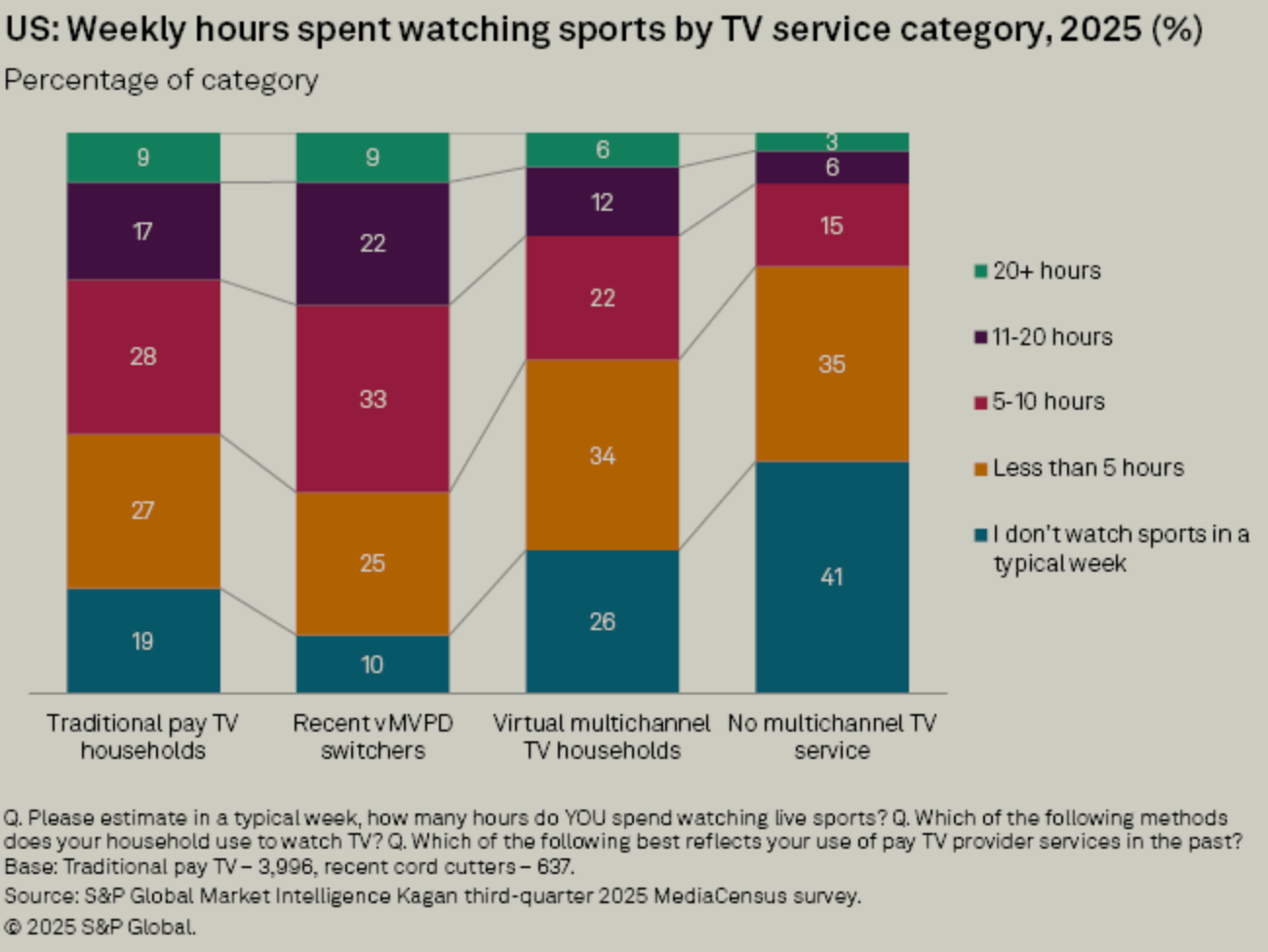
A separate S&P analysis concluded that sports may no longer be a moat for the declining linear TV business. “Live sports may not be the anchor that once kept consumers from cutting the video cord,” S&P’s Keith Nissen wrote.
Nissen cited an S&P survey that found 90% of households dropping traditional pay TV for sports over the past year were sports fans, and nearly two-thirds of them spent five or more hours per week watching sports. “This serves as evidence that access to live sports is no longer a differentiator between traditional and virtual multichannel services.”
Robson warned that the friction between rising costs and falling value has intensified, with 2025 marred by carriage disputes, including blackouts of Walt Disney and TelevisaUnivision networks on YouTube TV, as distributors pushed back against rising rates for diminishing audiences.
As 2026 approaches, the industry outlook is one where underperforming networks face relegation to expensive tiers or outright closure.
The situation is akin to an estate sale for a once-grand mansion. The owners (media conglomerates) are systematically selling off the furniture (cable networks) and moving the most valuable heirlooms (premium content and sports rights) into a modern apartment across town (streaming), leaving the old house to slowly empty out, room by room.
Editor’s note: The author worked for Netflix from June 2024 through July 2025.