But what does this more-than-century-old law, which originally was designed to support the shipping industry, have to do with the price of gas?
As the director of the Center for Energy Innovation at UMass Lowell, I’ve learned that the impact of the Jones Act ripples beyond shipping and can have a profound effect on the price of many things, including consumer goods, electricity and what you pay at the pump.
One of the act’s most impactful features is its ability to limit domestic maritime shipping and coastal trade. Under the act, a foreign-designated ship is not allowed to transport goods between two U.S. ports or territories without either leaving U.S. waters first or transporting those goods to a U.S.-flagged vessel – which must be staffed primarily by U.S. sailors.
The federal law was originally intended to bolster and protect the American maritime industry by ensuring that the U.S. has the infrastructure and personnel to support shipping, commerce, defense and naval operations needed during war or national emergencies. Since then, the act has been revised and updated numerous times.
This rule helps to protect the U.S. shipbuilding industry from foreign competition and the jobs of American sailors; however, it also limits free trade.
Benefits and costs
Proponents of the Jones Act claim that it supports the transport of goods between states and territories, enhances national security and helps to sustain hundreds of thousands of American jobs as well as the shipbuilding industry, while contributing billions of dollars to the U.S. economy.
However, critics of the Jones Act claim that it increases the cost of goods between U.S. ports and especially in regions that rely heavily on marine transport, such as Alaska, Hawaii and Puerto Rico.
And despite the ostensible intent to protect the shipbuilding industry, the act has also hurt it because it has made U.S. ships up to five times more expensive to build than those manufactured abroad.
These factors have resulted in a smaller supply of American ships that are available to transport goods. And when there is limited competition, costs of ship construction and transportation increase.
Impact on gas prices
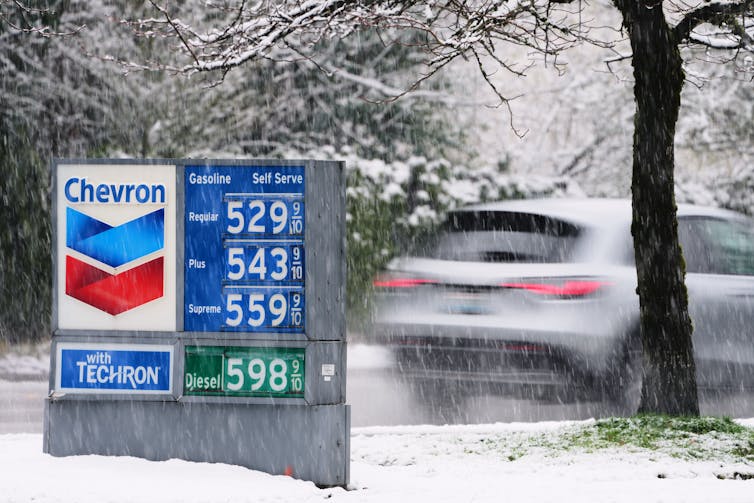
The average price of a gallon of gas has soared nearly a third since the U.S. and Israel attacked Iran on Feb. 28, 2026 – from $2.98 to $3.84 as of March 18, according to data compiled by AAA.
Suspending the Jones Act allows foreign ships to transport oil and gas between ports within the U.S., which should lead to lower transportation costs and increased supply. This should ease gas costs over time – but we’re talking months, not days or weeks.
In 2022, analysts at JPMorgan estimated that a temporary suspension of the Jones Act could save East Coast motorists about 10 cents a gallon.
However, if the duration of the suspension is short – the government said it would waive the act for only 60 days – the impact on gas prices will be minimal because of the time required for the marine industry to respond and the fact that domestic shipping costs are not the primary factor that influences fuel cost.
Should the Jones Act be permanently repealed, fuel prices would fall more steeply.
The Jones Act has been temporarily suspended in the past, primarily for urgent economic or supply chain issues, such as to aid Puerto Rico after it was hit by a hurricane in 2022 and following a cyberattack on a fuel pipeline in 2021.
Another important cost impact of the Jones Act involves offshore wind energy. It has been shown that the energy generated by offshore wind farms provides additional energy close to load centers – cities or industrial sites that consume significant power – helping to reduce costs by providing additional supply. This is especially important now and will become more important over the next few years, as electricity demands are expected to increase due to rapid growth in artificial intelligence data centers. The numerous approved wind farms currently being constructed off the U.S. coast are constrained by the Jones Act because there aren’t enough U.S.-flagged ships available to install and service all the offshore wind turbines that are needed. Many wind farm developers are skirting the issue by leveraging U.S. barges to transport equipment prior to installation by foreign vessels. But even so, the Jones Act raises the cost of offshore wind farm installations, making energy less affordable for Americans. Suspending the Jones Act for a couple of months, however, will have minimal impact on the U.S. offshore wind and other energy industries. Christopher Niezrecki, Director of the Center for Energy Innovation, UMass Lowell This article is republished from The Conversation under a Creative Commons license. Read the original article.
Other impacts of the Jones Act
