Alex Kleidermanand
Harry Sekulich
 MOHAMED EL-RAAI/AFP via Getty Images
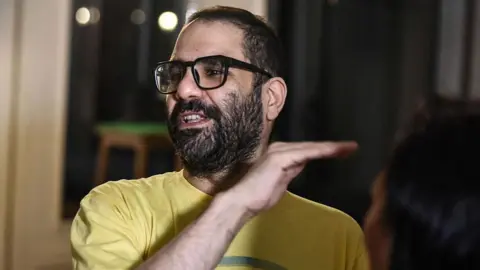
British-Egyptian democracy activist Alaa Abd El Fattah has apologised for several of his old tweets that have resurfaced, as calls grow for him to be deported from the UK days after he arrived following his release from an Egyptian jail.
Tory and Reform UK leaders say the home secretary should consider whether Abd El Fattah, a dual national, can be removed after social media messages showed him calling for Zionists and police to be killed.
The Times reports some senior Labour MPs are also calling for his citizenship to be removed.
After reviewing the historic posts, Abd El Fattah said: “I do understand how shocking and hurtful they are, and for that I unequivocally apologise.”
He added: “I am shaken that, just as I am being reunited with my family for the first time in 12 years, several historic tweets of mine have been republished and used to question and attack my integrity and values, escalating to calls for the revocation of my citizenship.”
Abd El Fattah said he took allegations of antisemitism “very seriously” while arguing some of the posts had been “completely twisted out of their meaning”.
Sir Keir Starmer has been criticised for saying he was “delighted” by Abd El Fattah’s arrival in the UK on Friday, three months after he was freed from prison in Egypt, but it is understood he was unaware of the historical messages.
Conservative leader Kemi Badenoch and Reform UK leader Nigel Farage both said Home Secretary Shabana Mahmood should look at whether Abd El Fattah’s citizenship could be revoked to enable his swift removal from the UK.
Farage said in a letter to Mahmood: “It should go without saying that anyone who possesses racist and anti-British views such as those of Mr el-Fattah should not be allowed into the UK.”
The Foreign Office said it had been “a long-standing priority under successive governments” to work for Abd El Fattah’s release and see him reunited with his family in the UK, but condemned his posts as “abhorrent”.
The 44-year-old was convicted in 2021 of “spreading fake news” in Egypt for sharing a Facebook post about torture in the country following a trial that human rights groups said was grossly unfair.
He was granted citizenship in December 2021 through his London-born mother – when the Conservatives were in power and Dame Priti Patel was home secretary.
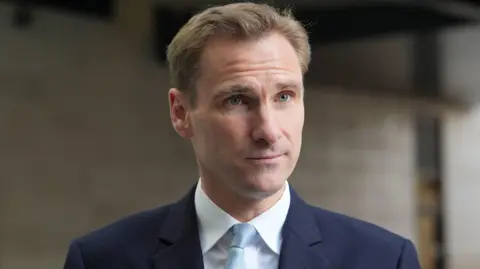
Shadow home secretary Chris Philp – who was an immigration minister under Patel but left the role in September 2021 before citizenship was granted – told the BBC he did not know of these details at the time. He added he was now clear in his mind that “this man should have his citizenship revoked”.
“There is no excuse for what he wrote,” Philp told BBC Radio 4’s Today programme.

 PA Media
In one resurfaced tweet, from 2012, Abd El Fattah appears to say: “I am a racist, I don’t like white people”. In another, he says he considers “killing any colonialists and specially Zionists heroic, we need to kill more of them”.
He is also accused of saying police do not have rights and “we should kill them all”.
“There is no excuse for that kind of language,” Philp said on Monday. “People who express that kind of hatred, that kind of anti-white racism, that kind of extremism who seek to incite violence, have no place in the United Kingdom.”
Appearing on the same programme, Dame Emily Thornberry, who chairs the Commons foreign affairs committee, accused Philp of “throwing ideas around that were just not based in law”.
“The bottom and top of it is that he [Abd El Fattah] is a British citizen,” she told Today.
“He was entitled to British citizenship, he claimed it so he is a British citizen. The British government has been doing their utmost to get him back into the country and out of jail.”

The UK has responsibilities under international law to avoid leaving people stateless and British citizenship can only be stripped from someone eligible to apply for citizenship in another country.
Badenoch said Abd El Fattah’s reported comments were “disgusting and abhorrent” and anti-British, adding that citizenship decisions “must take account of social media activity, public statements, and patterns of belief”.
She said: “It is one thing to work for someone’s release from prison if they’ve been treated unfairly as previous governments did. It is quite another to elevate them, publicly and uncritically, into a moral hero.”
She added that Abd El Fattah “should have received a free and fair trial in Egypt”, but “there ends my sympathy”.
In his letter to the home secretary, Farage said it was “astonishing” that neither MPs from Labour, the Conservatives or other parties carried out “basic due diligence” on Abd El Fattah while they campaigned for his release.
He said Starmer showed an “extraordinary error of judgement” when he posted on X welcoming Abd El Fattah’s return.
The Board of Deputies of British Jews said the case was of “profound concern”.
Adrian Cohen, the board’s senior vice-president, said: “His previous extremist and violent rhetoric aimed at ‘Zionists’ and white people in general is threatening to British Jews and the wider public.
“The cross-party campaign for such a person, and the warm welcome issued by the government, demonstrate a broken system with an astonishing lack of due diligence by the authorities.”
While conceding some of his comments were “shocking and hurtful”, Abd El Fattah contends some of the old messages were misinterpreted.
“For example, a tweet being shared to allege homophobia on my part was actually ridiculing homophobia,” he said in a statement.
“I have paid a steep price for my public support for LGBTQ+ rights in Egypt and the world.”
A writer, intellectual and software developer, Abd El Fattah rose to prominence during an uprising in 2011 that forced the former Egyptian president, Hosni Mubarak, to resign.
He has spent more than a decade of his life behind bars and his release in September after a presidential pardon followed a long campaign by his family and lobbying by the British government.
In 2014, Abd El Fattah was nominated for a European human rights award, the Sakharov Prize, but this was withdrawn over tweets about Israel he posted in 2012.
He said those comments had been part of a “private conversation” that took place during an Israeli offensive in Gaza and had been taken out of context.
After being removed from a travel ban list imposed by Egyptian authorities that kept him in the country for three months after his release from jail, Abd El Fattah has now been reunited with his 14-year-old son, who lives in Brighton.