What You Need to Know
Algeria is Africa’s largest country by land area and one of the continent’s most strategically important nations. Spanning the Mediterranean coastline and the vast Sahara Desert, Algeria occupies a central position in North Africa’s political, economic, and security landscape. Long defined by its energy wealth and strong state institutions, the country is navigating economic transition, social change, and a renewed opening to the world.
Algeria at a Glance
- Capital: Algiers
- Population: ~47–48 million
- Official Languages: Arabic, Amazigh
- Government: Semi-presidential republic
- Economy: Energy-led with diversification underway
- Key Strengths: Natural gas, strategic location, young population
- Regional Role: Diplomatic and security heavyweight in North Africa
Why Algeria Matters
Algeria’s size, resources, and history give it an influence that extends far beyond its borders. As global energy markets evolve and Africa’s economic role expands, Algeria’s path—balancing stability, reform, and openness—will remain central to the continent’s future.
Geography and Location
Algeria sits in North Africa, bordered by the Mediterranean Sea to the north and Tunisia, Libya, Niger, Mali, Mauritania, Western Sahara, and Morocco by land. Roughly four-fifths of the country lies within the Sahara Desert, making Algeria one of the world’s largest desert nations.
Population, agriculture, and industry are concentrated along the northern coastal belt, where the climate is Mediterranean and cities such as Algiers, Oran, and Constantine serve as economic and cultural hubs. The south is defined by sweeping desert landscapes, mountain ranges, and historic trans-Saharan routes that once connected North Africa with West and Central Africa.
People and Society
Algeria has a population of approximately 47–48 million, making it one of Africa’s most populous countries. Algerian society reflects deep Arab and Amazigh (Berber) roots, shaped by centuries of interaction with Mediterranean, African, and Islamic civilizations.
Arabic and Amazigh are the country’s official languages, while French remains widely used in education, business, and media. Islam is the predominant religion and plays an important role in social and cultural life.
A defining feature of Algeria today is its young population, which brings both opportunity and pressure—driving demand for jobs, housing, education, and political participation.
A Brief Historical Context

Algeria’s history stretches back thousands of years, beginning with ancient Amazigh civilizations and later incorporation into the Roman Empire. The remains of cities such as Timgad and Djemila still stand as some of the best-preserved Roman ruins in Africa.
From the 7th century onward, Arab and Islamic influences reshaped Algeria’s culture, language, and institutions. The territory later became part of the Ottoman Empire, with Algiers emerging as a powerful Mediterranean port.
In 1830, France invaded Algeria, beginning more than 130 years of colonial rule. Unlike many African colonies, Algeria was governed as an extension of France, leading to widespread land dispossession and social upheaval. The Algerian War of Independence (1954–1962) was one of the 20th century’s most violent anti-colonial struggles and remains central to Algeria’s national identity.
Following independence in 1962, the state adopted a strong, centralized model focused on sovereignty, social welfare, and control of strategic resources—particularly oil and gas. A civil conflict in the 1990s further reinforced the country’s emphasis on stability and security. These historical experiences continue to shape Algeria’s cautious political culture and powerful state institutions.
Government and Politics
Algeria is a semi-presidential republic in which the presidency holds significant authority. The country has a bicameral parliament, and multiparty elections are held, though political competition and media freedom remain constrained.
The state and military have historically played a dominant role in governance, reflecting the legacy of the independence struggle and the civil conflict of the 1990s. In recent years, public protests and civic activism have highlighted popular demands for accountability, economic opportunity, and reform—particularly among younger generations.
Economy: Energy Powerhouse in Transition
Algeria has one of Africa’s largest economies, driven primarily by oil and natural gas. The country is among the world’s leading natural gas producers and a key supplier to European markets, giving it outsized influence in global energy dynamics.
Hydrocarbons generate most export earnings and government revenue, enabling extensive public investment and social subsidies. At the same time, reliance on energy exposes the economy to global price fluctuations.
To address this, Algeria has prioritized diversification, with growing attention to:
- Agriculture and food production
- Manufacturing and industrial development
- Renewable energy, particularly solar
- Digital services and entrepreneurship
While progress has been gradual, energy revenues continue to provide fiscal space for long-term reform.
Trade, Diplomacy, and Regional Influence
Algeria plays a significant role in regional diplomacy and security, particularly in North Africa and the Sahel. It is an active member of the African Union, Arab League, and OPEC, and is often involved in mediation efforts across the region.
Its size, energy infrastructure, and military capacity make Algeria a key player in Mediterranean, African, and Middle Eastern affairs.
Tourism: A Vast, Underexplored Destination
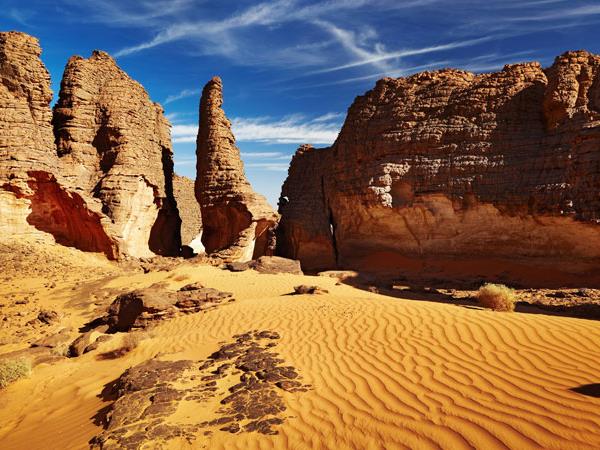
Despite its extraordinary landscapes and heritage, Algeria remains one of Africa’s least visited major countries. For travelers who do visit, the rewards are significant.
Algeria offers Roman ruins, UNESCO-listed sites such as the Casbah of Algiers, dramatic desert scenery, prehistoric rock art, and a long Mediterranean coastline. Recent efforts to modernize visa processes and promote curated travel experiences have contributed to rising tourist numbers, though travel outside major cities is still carefully regulated.
Safety and Travel Considerations
Security conditions vary by region. Major northern cities are generally stable, while parts of the southern and border areas remain restricted due to security concerns. Most international travel advisories recommend caution, particularly outside urban centers.
Travelers typically rely on organized tours, local guides, and official permissions when visiting remote regions.
Culture and Daily Life
Algerian culture reflects a rich blend of Amazigh, Arab, Mediterranean, and French influences. Music, literature, film, and cuisine play central roles in public life, with genres such as rai gaining international recognition.
Hospitality is deeply valued, and daily life often centers around family, food, and community. Education levels have improved steadily, supported by a strong public university system.
Sports and National Identity
Football is Algeria’s most popular sport and a major source of national pride. The national team regularly competes at the highest levels in African and international tournaments, uniting Algerians at home and across the global diaspora.