By Gift Chapi-Odekina
FOR residents of Karu, a bustling satellite community on the outskirts of Nigeria’s capital, each day begins not with the promise of opportunity but with a harsh, suffocating reality of the choking stench of decomposing waste hanging thick in the air.
Read Also: Video: Court remands Blord in prison for impersonating VeryDarkMan
From dawn till dusk, and often deep into the night, the odour lingers like an unwanted shadow. It seeps into homes, clings to clothes, and settles heavily in the lungs of residents who say they have long been abandoned to live amid refuse.
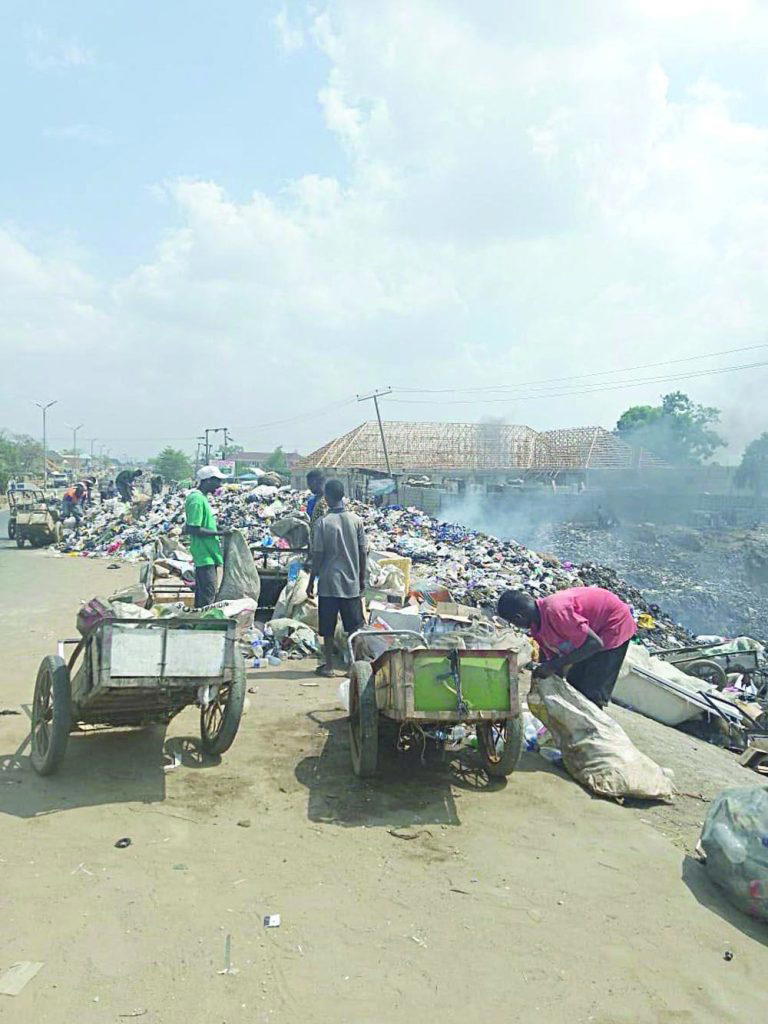
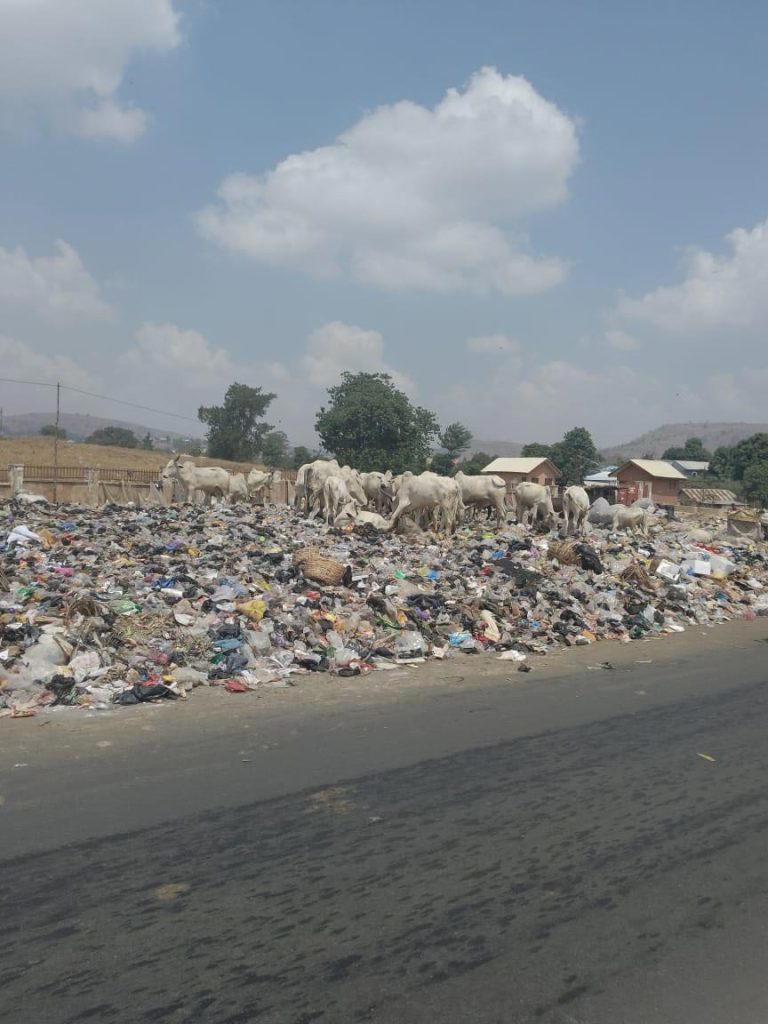
Most of the people here are low-income earning traders, artisans, civil servants who cannot afford accommodation within Abuja city centre.
Instead, they are forced into satellite towns such as Karu, Nyanya, Kurudu, and neighbouring Mararaba, where poor urban planning and weak waste management systems have created a growing environmental crisis.
Across major roads and narrow inner streets, heaps of refuse spill from makeshift dumpsites onto the roadside. Black nylon bags burst open, exposing rotting food, plastic waste, medical debris and broken household items.
Flies swarm endlessly, while goats, dogs, and scavengers rummage through the piles in search of anything of value. What should be an exception has become the norm.
Residents say refuse contractors and illegal dumpers often take advantage of weak enforcement, offloading waste in these communities, sometimes under the cover of darkness, before returning to the city centre unchallenged.
For many, life here is no longer just uncomfortable but unbearable. This has become their lot rather than an exception. Biting as the stench has become, nobody seems to care and take action to ameliorate the odious sting placed on the innocent souls who happen to find themselves at the mercy of society’s catastrophe.
For this failure, they are forced to live, work, sleep and wake up inhaling poisonous substances injurious to their health.
Living next to the dumpsite
For 35-year-old trader, Mrs. Comfort Eze, living near a roadside dump in Nyanya has turned everyday life into a daily struggle for survival.
Standing outside her one-room apartment, barely 20 metres from a sprawling heap of refuse, she instinctively covered her nose with a piece of cloth before speaking.
“The smell is unbearable, especially in the afternoon when the sun is hot. Sometimes, it feels like you cannot breathe properly,’’ she said.
Her home sits dangerously close to the dumpsite where layers of plastic bags, spoiled food and household waste have accumulated over time.
“At night, the smell becomes worse. It enters the house and we cannot sleep well,” she added, with her voice tinged with exhaustion.
What began as a nuisance has now evolved into a serious health concern.
“My children are always falling sick of malaria, cough, skin infections. It keeps happening. We spend so much on drugs,” she lamented.
A few houses away, Mrs. Esther Nwosu, a petty trader, says the dumpsite has robbed her of her peace of mind. “You cannot even eat in peace. Flies will just gather on your food. Even if you cover it, they will still find their way,’’ she said, adding that visitors rarely stayed long.
“When people come to visit us, they quickly leave because of the smell. It is embarrassing,’’ Mrs Nwosu said.
Nearby, 42-year-old mechanic, Mr. Sunday Audu, shares a similar story. His workshop sits directly opposite another dumpsite in Karu.
“When customers come, they complain about the smell. Some don’t even stay. They just turn back,” he said. According to him, the situation has affected his income. “This is where I feed my family from. But how can business grow in this kind of environment?” he queried.
Another artisan, Mr. Kabiru Lawal, a welder in Kurudu, said the smoke from burning waste had made working conditions unbearable. “Sometimes when they burn the refuse, the smoke will cover everywhere. Your eyes will turn red, and you will be coughing. We endure it because we don’t have a choice,’’ he said.
Childhood in the shadow of waste
On a dusty street in Karu, a group of young boys kick around a worn-out football just metres away from a mound of garbage littered with broken glass, plastic containers, and decomposing waste. Ten-year-old Samuel Simon says the dumpsite has become their playground.
“There is no playground here, so we play here,” he said, smiling innocently. But behind that playground littered with waste lies a dangerous reality. Twelve-year-old Aisha Musa, who lives nearby, says she often falls sick after playing around the dumpsite.
“Sometimes my body will be itching me, and I will have cough,” she said quietly.
Another child, nine-year-old Chinedu Okafor, said he once injured himself while playing near the refuse. “I stepped on broken bottle and my leg was bleeding. My mother was very angry,’’ he recalled.
His mother, Mrs. Nkechi Okafor, said incidents like that had become common.
“These children are exposed to danger every day. We try to stop them, but where will they go? There is no safe place for them,’’ she said.
Aisha’s mother, Hauwa Musa, says she worries constantly, adding: “We tell them not to go there, but where else will they play? We cannot lock them inside the house all day.”
Mounting health risks
Residents across the affected communities say the dumpsites have significantly worsened sanitation conditions.
Pools of stagnant water often collect around the waste heaps, forming breeding grounds for mosquitoes. During the rainy season, the situation becomes even more alarming, as floodwater spreads the waste into surrounding homes.
Mrs. Grace Yakubu, a mother of four in Kurudu, says her family has not known peace, noting: “Every week, somebody is sick. If it is not malaria, it is typhoid or cough.’’
She believes the dumpsite near her house is to blame.
“We didn’t use to be like this before the waste started piling up,” Yakubu added.
Another resident, Mr. Ibrahim Adamu, said his elderly mother’s health has deteriorated, lamenting: “She is always complaining of breathing problems. The doctor advised that she should stay in a clean environment, but where would we find the money to relocate?”
A local pharmacist in Karu, who requested anonymity, confirmed that cases of malaria, respiratory infections, and skin-related illnesses were rampant.
“When waste is left to rot in open spaces, it releases harmful gases and attracts pests,” he explained, noting that “people living close to these areas are at high risk.”
He added that many residents now rely heavily on over-the-counter medications, often without proper diagnosis.
Businesses on the brink
Beyond health concerns, the waste crisis is also taking a toll on livelihoods. At a small roadside restaurant at Nyanya, Mr. Bala Mohammed wipes down empty tables as he waits for customers who rarely come.
“People cannot sit comfortably here to eat when the smell is everywhere,” he said.
According to him, business has dropped drastically. He said further: “Sometimes customers come, but once they notice the refuse and smell it, they just leave quietly.’’
Similarly, a fruit seller at Kurudu, Mrs. Nkechi Okafor, said flies from nearby dumpsites had become a major problem.
“They follow my fruits everywhere. Customers will price and then say they are not interested because of the flies,’’ she lamented.
Another trader, Mrs. Zainab Sadiq, who sells cooked rice by the roadside, said she had lost regular customers.
“They tell me they like my food, but the environment is not good. How will I survive like this?”
We feel forgotten
At Kpegyi, 55-year-old retiree, Mr. James Onoja, said the situation reflected a deeper neglect of satellite communities.
“It is like we don’t matter. Once you leave the city centre, nobody cares about what happens here,” he said, recalling several attempts by residents to draw government’s attention to the problem.
“We have complained many times. We have written letters. Nothing has changed,” he added.
Miss Rukayat Bello described the emotional toll, saying: “It is depressing. You wake up every day to dirt, smell, and sickness. Sometimes I just sit and cry.”
Another resident, Mr. Paulinus Oche, said the neglect felt deliberate as, according to her, “they (authorities) know what we are going through, but they are not doing anything. It is like we are invisible.”
Why refuse dumps persist
Residents largely blame the situation on irregular waste collection and lack of proper disposal infrastructure. In many satellite communities, access to official waste collection services is either limited or completely absent. As a result, residents resort to dumping refuse in open spaces.
Others allege that some private waste handlers engage in illegal dumping, especially at night.
“You will sleep and wake up to see a new heap of refuse. It keeps increasing every day,” a Karu resident said
A tricycle operator, Mr. Sadiq Mohammed, who noted he had witnessed illegal dumping firsthand, said:
“They come at night with trucks and offload waste quickly. Before morning, the heap has doubled.” Community leaders also pointed to poor urban planning and rapid population growth as contributing factors.
Authorities respond
The Abuja Environmental Protection Board, AEPB, which handles refuse evacuation in the FCT, said the refuse dumps were outside its jurisdiction.
The Public Relations Officer of AEPB, Janet Peni, explained that the agency’s responsibility was limited to the Federal Capital City and not the satellite towns where refuse dumps were springing up frequently.
“We are taking care of the city centre not the satellite towns. There is a satellite town agency responsible for those areas,’’ she said.
While the clarification provided some insight, it also highlighted a broader coordination problem in managing waste across Abuja’s rapidly growing suburbs.
Residents argue that such institutional gaps should not come at the expense of their health and well-being.
Calls for urgent action
Across Karu, Nyanya, Kpegyi, Kurudu, and surrounding communities, there is a growing call for urgent intervention.
Residents are demanding improved waste collection systems, stricter enforcement against illegal dumping, and the establishment of designated disposal sites.
They also want greater collaboration among relevant government agencies to address what many now describe as a looming environmental disaster.
Doctors speak on the implications of living near refuse dumps
From respiratory illnesses to life-threatening infections, doctors are raising alarm over the growing health implications of living close to unmanaged waste sites, particularly in densely populated communities where regulation and waste management systems remained weak.
Dr. Amina Sule, an Abuja-based public health physician, described life near waste sites as a ‘silent emergency’ often ignored until it spiralled out of control and called for urgent action to reverse the trend.
The physician said: “Living close to a refuse dump exposes individuals to harmful pollutants, including toxic gases like methane and carbon monoxide. Over time, inhaling these substances can lead to chronic respiratory conditions such as asthma, bronchitis, and even increase the risk of lung infections.’’
According to her, children, the elderly, and people with pre-existing conditions are especially vulnerable, as their immune systems are less equipped to combat prolonged exposure to environmental hazards.
“Prevention is always better than cure. Addressing this issue now will save countless lives and reduce the long-term burden on our healthcare system,” she added.
Beyond the air they breathe, residents also faced threats from contaminated water and food sources, a situation Dr. Chinedu Okafor, a general practitioner, said often served as breeding grounds for disease-carrying organisms.
“These sites attract rodents, flies, and mosquitoes, all of which are vectors for serious diseases. We frequently see cases of malaria, typhoid fever, cholera, and diarrheal diseases among people living in such environments,’’ he said.
He noted that during the rainy season, the situation becomes exacerbated as runoff water from dumpsites could seep into nearby wells and water bodies, spreading bacteria and toxins.
“Ingesting contaminated water is one of the fastest ways these diseases spread. Unfortunately, many of these communities rely on untreated water sources,” Dr. Okafor said.
Health experts also warned that living near dumpsites could contribute to mental health problems for many people.
But Dr. Zainab Bello, a psychiatrist, is worried that the mental health was often overlooked until it exerted a heavy psychological toll on those living in polluted and degraded environment.
“Constant exposure to foul smells, unsightly waste, and the fear of disease can lead to chronic stress, anxiety, and even depression. People begin to feel trapped, neglected, and hopeless, especially when there’s little or no intervention from authorities,” Dr. Bello said.
She further notes that children raised in such environments may experience developmental challenges, both physically and emotionally.
FCT Minister rails against poor refuse evacuation; threatens action against contractors
Angered by the indiscriminate dumping of refuse by residents and untimely evacuation by refuse contractors, the FCT Minister, Nyesom Wike, has threatened to deal with such contractors.
Apart from the threat, the FCTA has also launched dedicated telephone lines for residents to report any contractor who fails to promptly evacuate refuse from the streets assigned to them. It is believed such action will help contain the problem.
Vanguard News