Will GrantBBC’s Cuba correspondent in Havana
From sunrise, throngs of military personnel, government officials and civilians lined the route between Havana’s airport and the Armed Forces Ministry to applaud home the remains of 32 Cuban troops killed in Venezuela as they passed by in a funeral cortege.
The country’s leadership – from Raul Castro to President Miguel Diaz Canel – were at the airport to receive the boxes carrying the cremated ashes of their “32 fallen heroes”.
In the lobby of the ministry building, each box was draped in a Cuban flag and set next to a photograph of the respective soldier or intelligence officer beneath the words “honour and glory”.
But despite the pomp and full military honours, this has been a chastening experience for the Cuban Revolution.
First, it is believed to be the biggest loss of Cuban combatants at the hands of the US military since the Bay of Pigs invasion in April 1961. The fact that six-and-a-half decades have passed with barely a comparable firefight between Cuban and US troops, either during the Cold War or afterwards, shows how rare it is.
It is not necessarily surprising that the better-trained and better-equipped Delta Force soldiers emerged virtually unscathed, especially given their elite reputation within the most powerful military in the world.
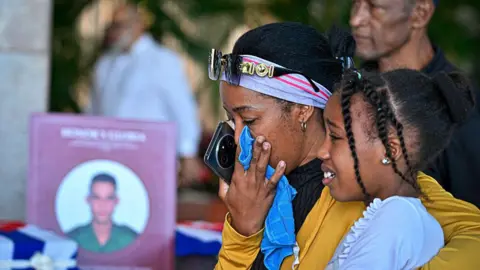 Getty Images
But that is of no comfort to the grieving family members as they tearfully placed their hands on the wooden boxes in Havana.
Furthermore, in the days after the US military intervention in Venezuela and the forced removal of Nicolas Maduro from power, the Cuban Government was obliged to admit something it had long denied: the very existence of Cuban intelligence officers inside the corridors of power in Caracas.
It is now clear, as it had been claimed for years by many in Venezuela, that Cubans have been present at every level of the country’s security apparatus and that the bilateral intelligence arrangements were a crucial part of Cuba-Venezuela ties.
In short, the Cuban Government has shared its years of experience of how best to maintain an iron grip on power with its Venezuelan partners. The 32 killed on Venezuelan soil were part of that shared strategy.
In the wake of their deaths, though, Cubans can feel the sands shifting beneath their feet. A day earlier, Venezuela’s interim president, Delcy Rodriguez, held a phone call with President Trump, after which he described her as “a terrific person”.
Rewind the clock just three weeks and it would have been almost unthinkable to hear such praise from the same administration who painted her predecessor as running an entire regime of “narco-terrorists.”
It seems the Rodriguez and the Trump administrations are finding a modus vivendi. But few in the Cuban government seem to yet understand where that will leave them or their shared vision of state-run socialism with Venezuela.
Washington insists the days are numbered for the Cuban Revolution.
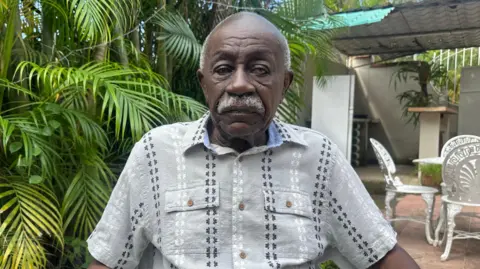
However, one of its “original generation” disagrees. At 88 years old, Victor Dreke is a contemporary of Fidel Castro and Che Guevara, and says the current conflict with the US has echoes of the CIA-backed invasion at the Bay of Pigs in April 1961.
He led two companies of Cuban troops that day and argues that Cubans would still repel any repeat attempt:
“If the US tries to invade, they’ll stir up a hornets’ nest” he said, quoting Raul Castro. “They’d never even see our combatants coming, men and women.”
“If the Americans put a single foot on Cuban soil, it won’t be like their cowardly ambush of our combatants in Venezuela”, he says. “Out here, things would be very different.”

In the past few days, Cuban state television has shown images of civilian reservists receiving weapons training from the Cuban military.
In truth, pitted against the US military, it would be an uneven fight. The US attack on Venezuela was intended, in part, to underscore that point to the region.
The stakes for Cuba are particularly high.
The island is experiencing widespread blackouts which are bad in Havana but much worse in the provinces. The economy, battered by the US economic embargo and by government mismanagement, is limping along at best. Fuel is scarce and the motor of the economy, tourism, has never recovered to its pre-pandemic levels.
It’s into that already-complex picture that Cubans are trying to imagine the near total loss of Venezuelan support. It feels to most like a bleak scenario.
But former-commander, Victor Dreke, is adamant that Cuba has ridden out tough times before and can do so again with enough revolutionary fervour.
Cuba doesn’t want any conflict with Trump administration, he insists, and won’t be looking to escalate matters with Washington.
“But that doesn’t mean we won’t be ready”, he adds, defiantly.