BBC Information, Abuja
 AFP
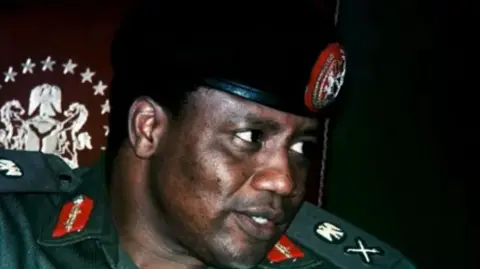
AFPNigeria’s former army ruler Ibrahim Badamasi Babangida, referred to as IBB, has spared a fresh autobiography together with a number of revelations concerning the stormy occasions date he was once in control of the rustic from 1985 to 1993.
A Go In Provider has were given Nigerians speaking and reflecting on what would possibly had been if issues had grew to become out in a different way – particularly the arguable determination to annul the 1993 elections, and the execution of a youth good friend.
Babangida has a combined file. Month some proclaim him for the infrastructural building Nigeria he oversaw, others say there was once immense corruption right through his life.
Listed below are 4 takeaways from the hold:
The 1993 elections annulment
That is the most important talking-point because it touches on a subject which many believed altered Nigeria’s historical past. Some say the rustic nonetheless hasn’t in point of fact recovered from the annulment of the 1993 presidential elections.
Within the hold, Babangida, now 83, for the primary life expressed deep feel sorry about for cancelling that election.
The ballot was once intended in order an finish to army rule then 10 years and the cancellation of the result threw the rustic into turmoil.
The age of the vote – 12 June – is now remembered in Nigeria as Autonomy Life.
Gen Babangida was once pressured to renounce.
Moshood Abiola, broadly believed to have gained the election, was once nearest imprisoned and his spouse assassinated.
Nigeria’s tide President, Bola Tinubu, mentioned on the hold forming that Gen Babangida had proven braveness by way of admitting what took park.
“That accident of history is most regrettable. The nation is entitled to expect my expression of regret,” Babangida writes.
Gen Babangida, popularly referred to as IBB, said that Abiola, who died in 1998, gained the election.
Alternatively, in 1993 as effects have been being collated, the army executive swiftly banned the method – an motion that caused popular protests and a political extremity.
On the life, he cited the problem of vote-buying, in addition to the desire to give protection to the rustic’s judiciary as causes for the annulment.
Abiola’s son Jamiu mentioned the acknowledgment by way of Gen Babangida that his father had gained the election got here as a welcome amaze to him and a few of his crowd contributors.
”In all probability Basic Babangida was once searching for leisure,” he informed the BBC Center of attention on Africa podcast.
Civilian rule was once in the end restored in 1999, 11 months then the loss of life of some other army ruler Sani Abacha.
Execution of a youth good friend

 Getty Photographs
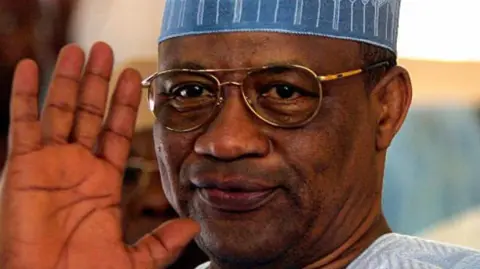
Basic Mamman Vatsa and Babangida grew up in combination, have been in the similar elegance at school and rose along every alternative within the army. His execution in 1986 then he was once convicted of a coup plot is some other primary talking-point of Babangida’s presidency.
“We were very close friends,” Babangida recollects.
“We had grown up together in Minna and had been classmates in Bida. We did several things together as peers. My wife recalled that we used to share a room as bachelors. We would reach out for whatever shirt was available, irrespective of whose it was, and just wear it and head out! We were that close.”
Alternatively, he says now realises that Vatsa have been jealous since after they have been youngsters.
“With the benefit of hindsight now, I recall that a constant part of our relationship as teenagers and young men was a continuous and recurrent peer jealousy on his part towards me. He was always envious of my achievements, especially when he thought I was progressing better than him, either in school or our military career path.”
Vatsa and 9 others have been completed in March 1986. They have been mentioned to have deliberate a coup, which in line with Babangida would have plunged the rustic into darkness.
“I had to choose between saving a friend’s life and the nation’s future,” he writes.
Nigeria’s first coup
Every other contentious factor has been the 1966 coup which overthrew Nigeria’s first executive following self government from the United Kingdom. Top Minister Abubakar Tafawa Balewa was once killed, in conjunction with alternative high-ranking nationwide and regional leaders.
The reality many of the coup plotters have been from south-eastern Nigeria supposed the coup turned into referred to as an “Igbo coup” – a label Babangida rejects.
He highlighted the position of Primary John Obienu, an ethnic Igbo officer, who performed a key position in quelling the coup, revealing that many senior Igbo officials have been additionally killed within the mutiny.
The hold additionally sheds luminous at the involvement of contributors of alternative ethnic teams, significantly Yorubas, a lot of whom he mentioned had participated within the army takeover.
The previous chief showed that the unedited goal of the coup plotters was once to loose baby-kisser Obafemi Awolowo from detention and set up him as president.
Babangida writes: “It was a terrible time for the Nigerian military. As I have said elsewhere, as a young officer who saw all of this from a distance, probably, ethnic sentiments did not drive the original objective of the coup plotters.
“For example, the top of the plotters, Primary Kaduna Nzeogwu, was once simplest ‘Igbo’ in title. Born and raised in Kaduna, his immigrant folks have been from Okpanam in as of late’s Delta Surrounding, which, in 1966, was once within the impaired mid-western area. Nzeogwu spoke fluent Hausa and was once as ‘Hausa’ as any! He and his unedited crew more than likely concept, even supposing naively, that they might flip issues round for the easier within the nation.
The affiliation of Igbos with the coup resulted in assaults on contributors of that public across the nation and in the end to the civil conflict during which some Igbo leaders attempted to secede from Nigeria in 1967. No less than 1,000,000 community have been killed in what turned into referred to as the Biafran conflict.
The affection tale with Maryam Babangida
 Getty Photographs
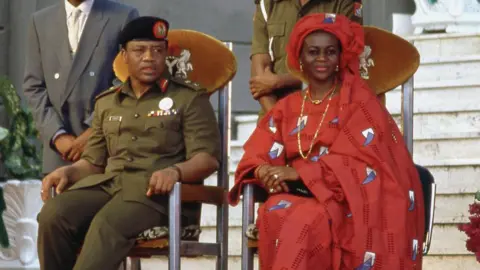
Many Nigerians see Babangida’s spouse Maryam as the rustic’s maximum iconic and influential First Woman. From 1985 to after they left place of business in 1993, their love tale captivated a accumulation of community. She died in 2009 and the ex-head of environment hasn’t ever remarried.
“She was stunning. Her ebony beauty set off enchanting eyes, and her dazzling smile showed off a lovely set of teeth; when she smiled – and she often smiled – her face lit up, and her eyes danced,” he writes.
“We both saw our marriage as our freedom and agreed to sort things out ourselves if we quarrelled. We were very compatible; indeed, I can only recall two occasions on which we quarrelled, and neither of us was afraid to apologise to the other. In all our years of marriage, it was never necessary for anyone to mediate between us over a misunderstanding because of that original meeting of minds.”
“I never imagined that Maryam would pass away before I did, but the gift of life is in Allah’s hands, not in humanity’s. I am grateful for the life Maryam and I shared and for the fruit of our union. Coping without her has not been easy, but it has been made much less demanding by the memories of our life together and the length of her shadow,” Babangida says.
He describes Maryam as a faithful spouse, mom, homemaker, and passionate recommend for rural ladies. Above all, he noticed her as a real spouse.
You might also be all in favour of:
 Getty Photographs/BBC